


The Department for Transport has revealed a Great British Railways identity featuring a Union Flag-style motif alongside the long-standing British Rail “double arrow” icon, and reports suggest it was created in-house rather than commissioned to an external agency.
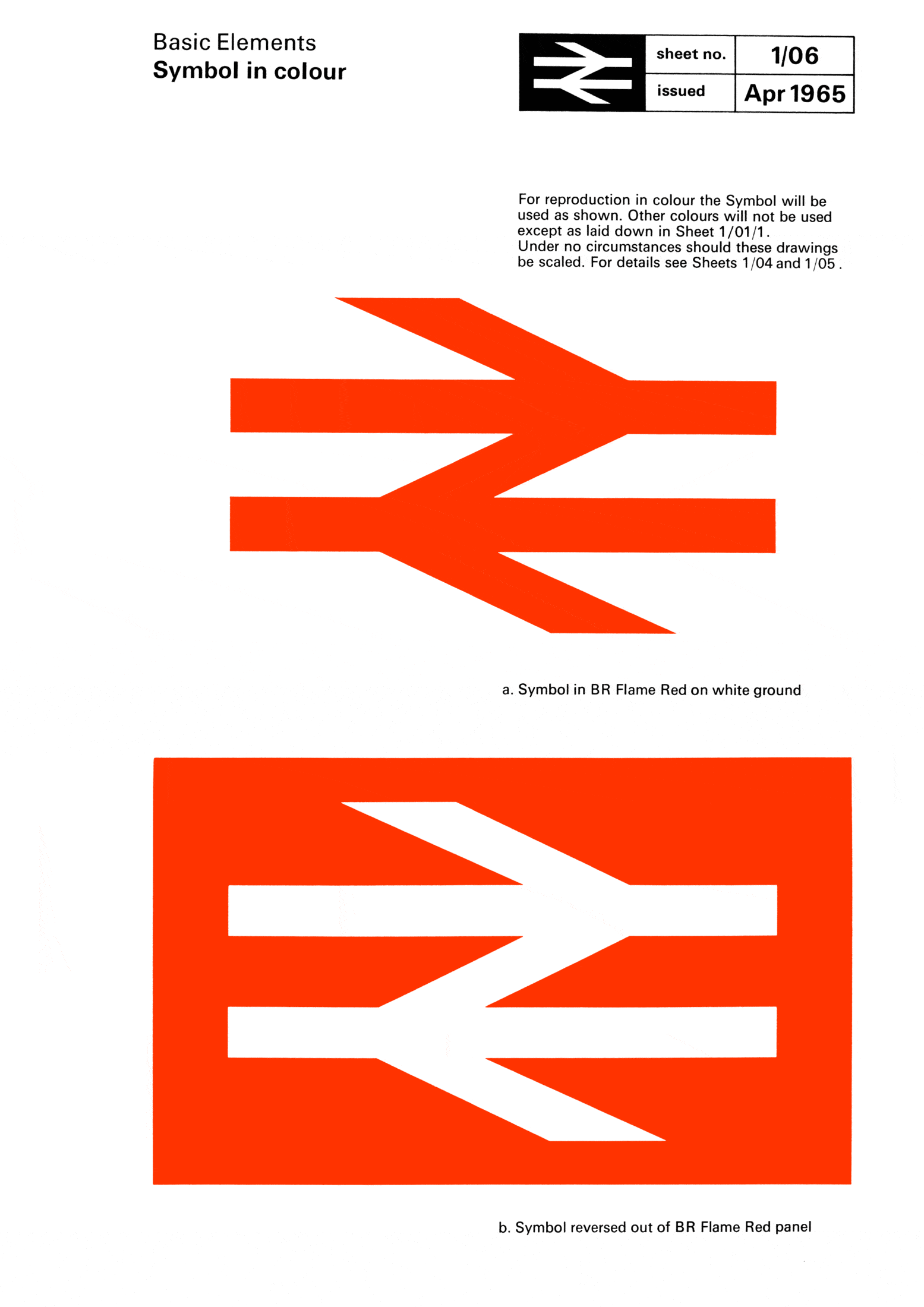
Before talking about the new identity, it is worth pausing on the symbol it is built around.
The British Rail “double arrow” is arguably one of the strongest pieces of design ever created for UK transport. Designed in 1965 by Gerry Barney at the Design Research Unit (DRU), it was originally conceived to resolve a simple problem:
How do you create a symbol that unambiguously represents “rail” for millions of people, across hundreds of contexts, at every possible size?

The genius of the mark lies in three things:
1. Absolute clarity of meaning
The two parallel lines represent the railway tracks, and the opposing arrows show the idea of movement in both directions.
It is simple, literal and instantly readable — even by someone unfamiliar with the system.
2. Scalability and flexibility
The double arrow was designed to work:
on huge station signage,
on tiny printed timetables,
on trains moving at 125mph,
in black-and-white or colour,
on physical and digital materials.
It is a true “system mark”: robust, legible and almost impossible to misinterpret.
3. Enduring public trust
Over six decades, the double arrow has become part of UK cultural memory. Even people who never knew British Rail still read it instantly as “train station” or “rail network”. It is still used by Network Rail and the Rail Delivery Group and remains a registered trademark.
When a symbol becomes part of everyday wayfinding, redesigning it is usually a mistake – so carrying it into the GBR identity is a sensible move that builds on trust and recognition already in people’s heads.


From a branding perspective, the intent feels clear:
Build instant recognition
Re-using the British Rail double arrow is a shortcut to familiarity. People already understand it as “rail”. Decades of use have made it one of the most recognisable transport symbols in the UK.
Convey national scale and authority
The Union Flag treatment is doing the “this is the national system” job in one glance. It suggests something official, central and nationwide.
Reduce fragmentation
A unified brand can make the system feel less like a patchwork of operators and more like one coherent service, especially if it is applied consistently across digital, stations, rolling stock and signage.

Even if you dislike the aesthetic, there are some practical wins in the approach:
Reuse of existing equity
The double arrow is already baked into public understanding. That is valuable brand equity you do not have to “buy” again with advertising spend.
Wayfinding first
Transport brands live and die by clarity in the real world, not by how they look in a launch deck. If the system leans on simple, well-understood symbols and strong hierarchy, it can improve usability even without radical visual innovation.
Where the ‘risk’ lies…
National imagery can quickly become political, especially in a multi-national state with differing views on identity and governance. For a service that needs broad public trust, overt flag branding may alienate some users as much as it reassures others.
If the passenger experience does not improve, a highly visible identity can become a lightning rod for criticism. The brand becomes the thing people blame every time there are delays, cancellations or poor communication.
A strong transport brand is usually a system, not just a symbol: typography, hierarchy, signage logic, iconography, tone of voice, and digital templates. If that system is not nailed and maintained, even a decent logo will not help much.

Whether you are a national public-sector body, or a small organisation:
A rebrand is not a logo. It is a system.
Brand strength comes from repeatable, consistent application, not just a new mark. The heavy lifting happens in the rules, patterns and templates that help your team produce on-brand outputs every week, across every channel.
If you are thinking about a rebrand or a refresh, start by asking:
What are we actually trying to make easier for people to understand?
Where does confusion currently happen (navigation, messaging, signage, content structure)?
Do we have clear templates, or is everything re-invented from scratch?
Can our team actually apply the brand without constant designer involvement?
Those are the questions that turn a visual refresh into something that improves real-world experience.
For more design news, take a look at the GOV.UK rebrand that was surprisingly controversial: “Why the £500k GOV.UK rebrand backlash misses the point”.
SHARE
https://gbrtt.co.uk/
https://www.gov.uk/government/collections/rail-reform
http://www.doublearrow.co.uk/home.htm
https://www.rail.delivery/
https://www.designweek.co.uk/issues/22-july-2019/double-arrow-british-rail-logo/
https://www.theguardian.com/uk-news
https://www.bbc.co.uk/news
https://www.railtechnologymagazine.com/articles/great-british-railways-branding